
Walkie-talkie options for group rides, compared
Last updated:
For talking while riding, a Bluetooth helmet intercom is the main tool; mesh units connect the whole group hands-free. FRS radios work without cell service and need no license. Phone voice apps use mobile data, so distance doesn't matter, but they suit stops or a passenger. Laiki hold-to-talk is the last kind, with a live group map built in.
Three ways to talk on a group ride
- Bluetooth helmet intercom: mounted on the helmet, voice- or button-operated, no phone in hand.
- Two-way radio: radios talk to each other directly, with no cell signal needed.
- Phone voice app: voice travels over mobile data, so distance doesn't matter as long as both sides have a connection.
Each solves a different problem, and many groups combine them.
Helmet intercom: the tool for talking while riding
Classic Bluetooth intercoms link riders in a chain. According to Sena, if a rider leaves the group or goes out of range, the chain breaks and has to be reconnected. In a mesh intercom, each rider connects directly to all the others, so the group keeps talking when someone drops out of range, and that rider rejoins automatically.
- Cardo Packtalk Edge: Cardo lists up to 1 mile unit to unit, up to 5 miles across the group, and up to 31 riders in a group intercom.
- Sena mesh units (for example the 50R): Sena lists 1.2 miles (2 km) of intercom range, extending up to 8 km with a group of at least 6 riders, and up to 24 riders in a private Group Mesh. Sena mesh is proprietary and needs Sena units; other brands connect over Bluetooth.
These are the makers' maximum figures. Hills, curves, and buildings shorten real range, and once the group stretches past it, the front and back can no longer hear each other.
FRS radios: no cell service needed
Handheld radios keep working in canyons and backcountry with no signal. In the US, the FCC says the Family Radio Service is licensed by rule, so the public can use FRS radios without getting a license. FRS has 22 channels shared with GMRS, which requires an individual license, so check which service a radio is built for before you buy.
Most handheld radios need a button press to talk, which is awkward while riding, so groups often hand one to the lead, the sweep, or a passenger.
Side by side
| Option | What you need | Range | Use while riding |
|---|---|---|---|
| Bluetooth mesh helmet intercom | A compatible unit on every helmet | Makers list about 1–1.2 miles unit to unit, up to 5 miles across the group | Yes, hands-free |
| FRS radio | FRS radios; no license | Depends on radio and terrain | Push to talk; best for a passenger or at stops |
| Laiki hold-to-talk | The Laiki app and mobile data | Any distance, as long as both have data | No; at stops or by a passenger |
Laiki hold-to-talk: talk to the whole group at a stop
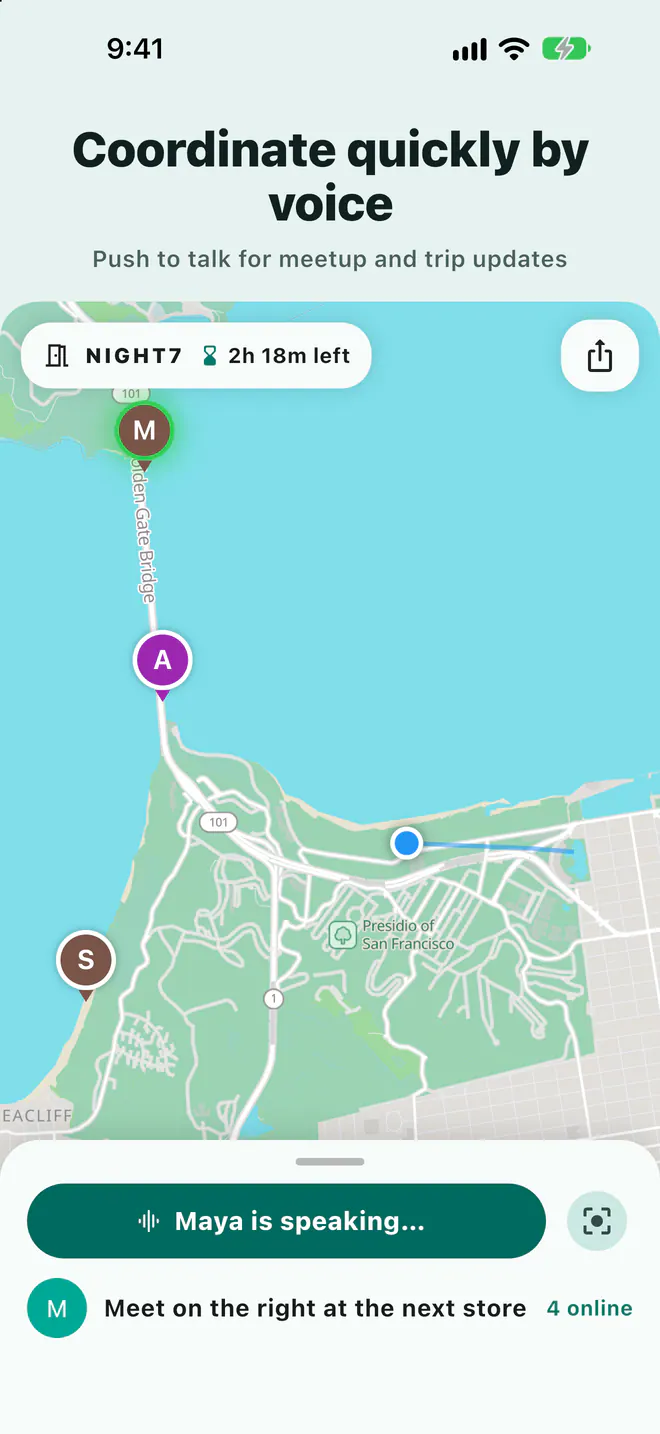
Laiki voice is internet voice, not a radio. Hold the talk button to speak and the whole room hears you; tap to keep the mic on. Everyone in the room can use voice, up to the room size.
What sets it apart from a helmet intercom is that voice and the map live in the same room:
- Reach riders far behind: when the group is spread well beyond intercom range, you can still talk as long as both sides have data.
- See who you're talking to: everyone's position, heading, speed, and phone battery are on one map, so "regroup at the next rest stop" means something.
- Move the meeting point: add or move a meeting point and the whole room sees it immediately.
Without a connection, voice doesn't work. On stretches with patchy coverage, rely on your helmet intercom and a regroup point agreed in advance.
Do not operate your phone while riding. Let a passenger use hold-to-talk, or stop somewhere safe first. Laiki does not replace a helmet intercom while riding.
A setup that works
- While riding: use helmet intercoms with the riders around you and keep your eyes on the road.
- Before leaving: open a Laiki room, post the link in the group text, and mark rest stops and gas stations.
- When the group spreads out or stops: check the map for who's where and use hold-to-talk to announce the next stop.
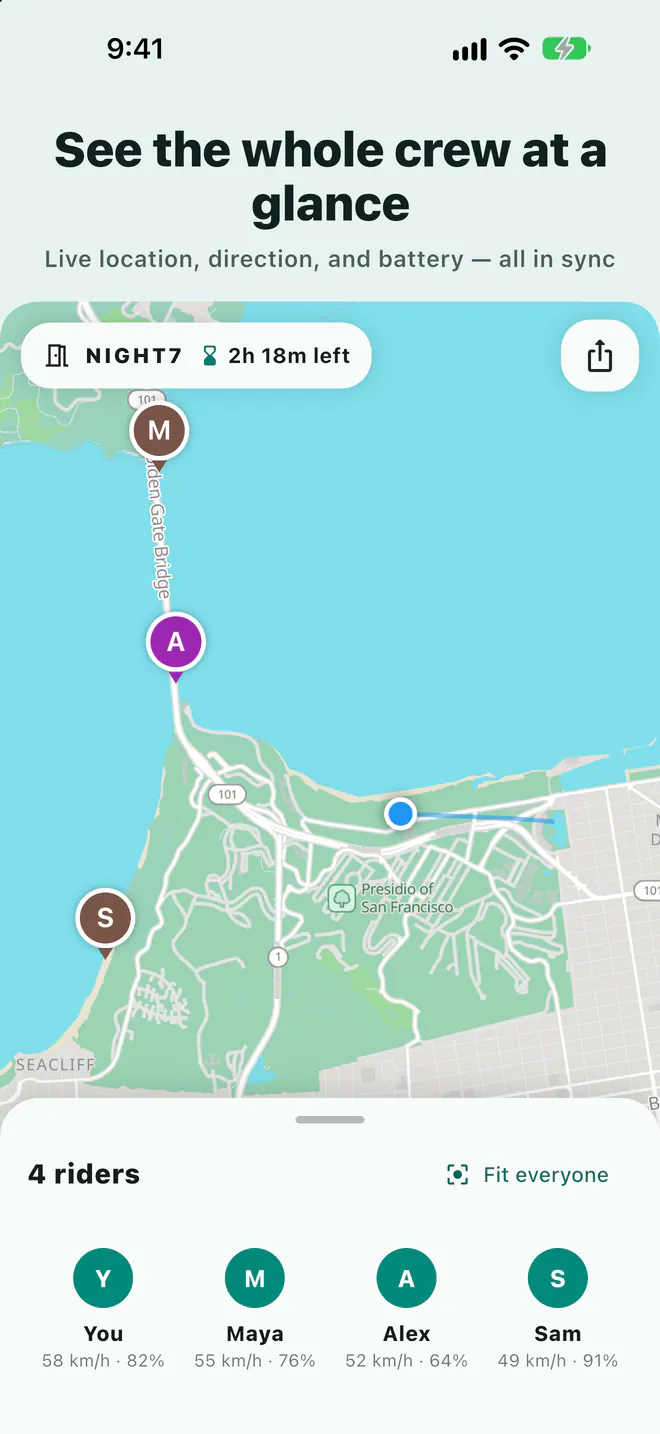
The free plan allows 8 people per room and rooms up to 3 days; rooms close automatically.
FAQ
Can Laiki replace a helmet intercom?
No. Laiki voice needs mobile data and a phone in hand. Use a helmet intercom while riding, and Laiki at stops or by a passenger.
Does Laiki voice work without cell service?
No. Laiki uses internet voice, so voice, location sharing, and meeting points stop updating without a connection.
Do I need a license for FRS radios?
No. The FCC says FRS is licensed by rule, so the public can use FRS radios without a license. GMRS, which shares those channels, requires an individual license.
Do different intercom brands work together?
According to Sena, its mesh needs Sena units, while other brands connect over Bluetooth. Cardo's spec sheet also lists cross-brand connectivity.
Sources
Related guides
- Group motorcycle rides: how does everyone know where everyone is?
- How do you share your location from an iPhone with an Android user?
- Multi-car road trip: how do you keep the cars together?
- Group bike rides: how do you keep from dropping anyone?
- Group hiking: how do you keep everyone together on the trail?
- Group rides and meetups: how do you collect RSVPs and check people in?
- How do you share your location temporarily without being tracked forever?
- Offline maps for group trips: what works without signal?
- Life360 alternative: temporary group sharing vs ongoing family location
Next trip, just open a room
The free plan already includes rooms, live location, meeting points, and planned routes.
Get Laiki